 Untilfree
How Long Will My Savings Last?
Two numbers decide most of the answer: how much you have and how much you take out each year. Growth and inflation adjust it, but spending is the part you control.
The short version
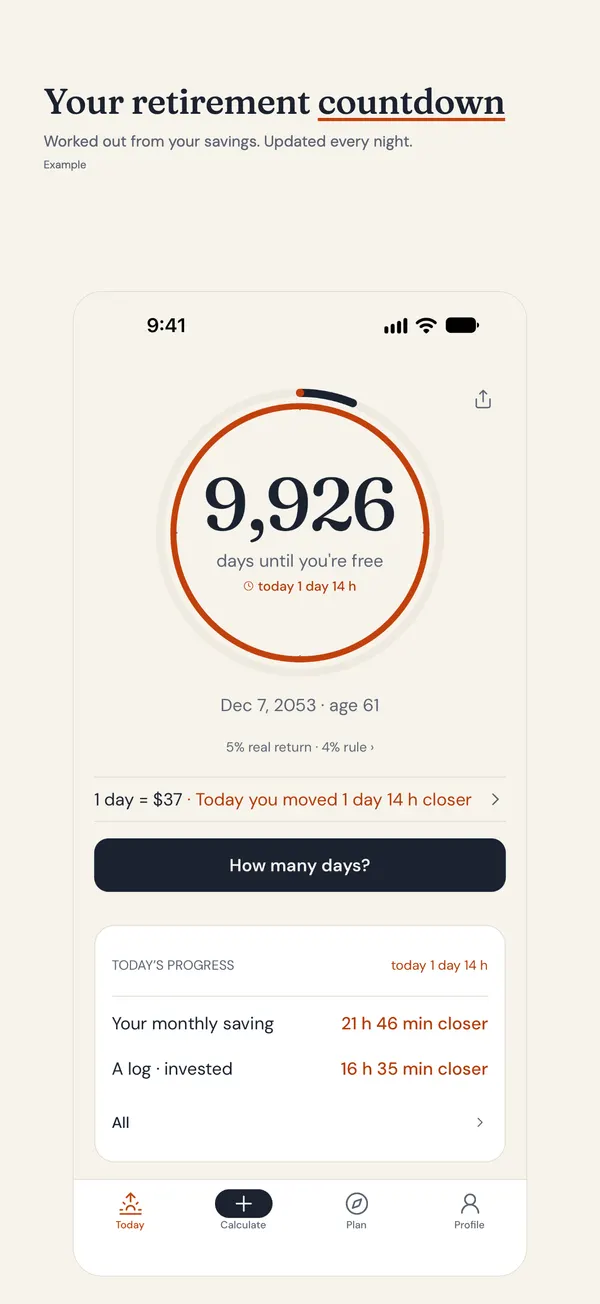
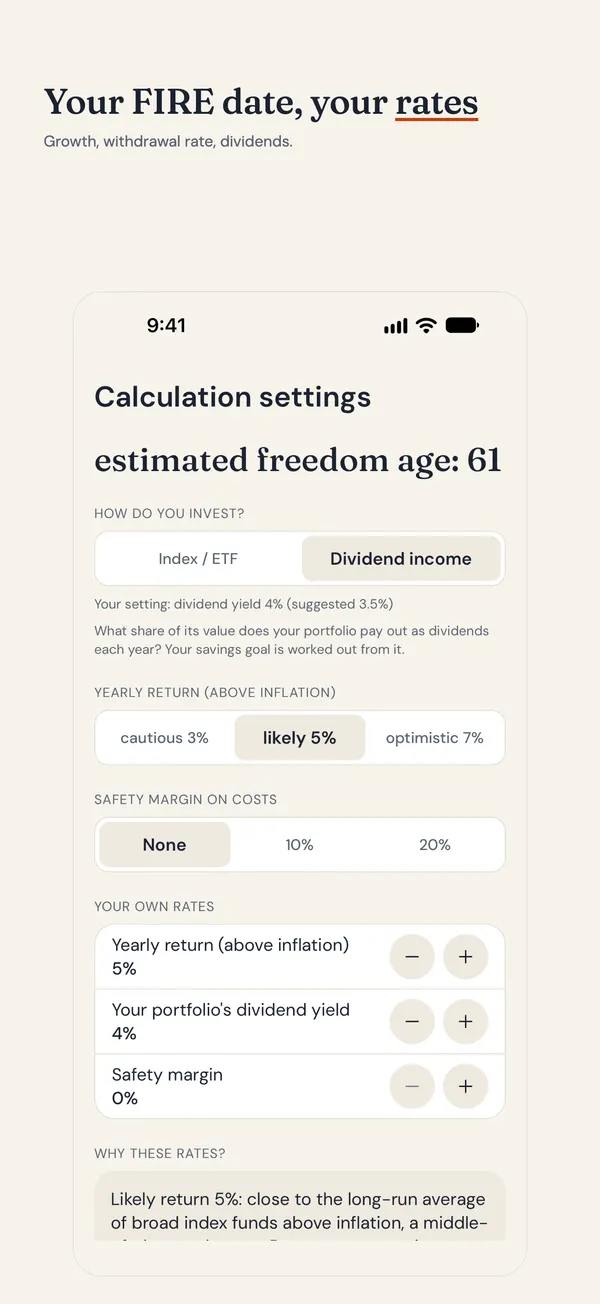
If you take out about 4% of your pot a year or less, the common rule of thumb treats it as sustainable, though nothing is guaranteed. Above that, the pot is slowly used up, and the more you take, the faster it goes. The estimate above uses 5% growth after inflation, so the spending figure stays in today's money.
The same pot at different budgets
Spending is not a small dial. A few thousand dollars a year can move the end date by a decade.
- $250,000 lasts about 20 years at $20,000 a year, and about 11 years at $30,000.
- $400,000 lasts about 23 years at $30,000 a year.
- $750,000 lasts about 37 years at $45,000 a year, and for good at $30,000 or less.
For specific amounts there are deeper guides: how long $500,000 lasts, how long $1 million lasts and how long $2 million lasts.
What about inflation?
Prices rise, so a fixed dollar amount buys less each year. There are two ways to handle that. One is to plan everything in today's money and use a growth rate after inflation, which is what Untilfree does. The other is to use nominal growth and raise your spending each year. Done consistently, both give similar answers; mixing them is where estimates go wrong.
Things a simple estimate leaves out
- Order of returns. A bad market in the first years shortens the life of a pot more than the same fall later.
- Taxes. Withdrawals from some accounts are taxed, which raises the gross amount you need.
- Other income. A pension or state benefit later reduces what savings must cover.
- Changing spending. Many retirees spend more early on and less later.
If the aim is to never run out, the question becomes "how big a pot for my budget", which is covered in how much money to never work again. If you only need savings to bridge a gap between jobs, the maths is simpler: how much money to quit your job sizes a months-of-spending cushion.
Ruth has $400,000 and spends $2,500 a month, $30,000 a year. The rough answer is about 23 years. If she brings that to $2,000 a month, the same pot stretches to about 37 years. Neither choice is right or wrong; the point is that she sees the trade.
Questions people ask
How long will my money last if I withdraw 4% a year?
By the research behind the 4% rule, a pot drawn at 4% a year, adjusted for inflation, lasted at least 30 years in almost all past US periods. Many people treat it as lasting for good, which is a hope rather than a certainty.
How long will $300,000 last in retirement?
At $20,000 a year it lasts about 28 years, at $30,000 about 14 years, using 5% growth after inflation. At $12,000 a year or less it is within the 4% rule.
Should I include inflation?
Yes, one way or another. Untilfree keeps everything in today's money and uses growth after inflation, so your spending figure does not need adjusting.
How long will my savings last with no growth?
It is the pot divided by yearly spending: $300,000 at $30,000 a year lasts 10 years with no growth. Growth stretches that, which is why the estimate above is longer.
What if I have a pension too?
Then only the part of your spending the pension does not cover has to come from savings, which makes the pot last longer. Untilfree counts only savings.
See which bills your savings already pay
Add your bills and Untilfree shows which ones your savings already cover, smallest first: "paid for, forever". Then it counts down to the day they cover all of them.
- Bills covered one by one
- Index funds (4%) or dividend income (3.5%), with your own rate
- No account and no bank link
App Store · Free · Ads, optional Plus · No account · No bank link
Untilfree gives estimates in today’s money (after inflation). Taxes and state pensions are not included. This page is general information, not investment advice.
Published · by Srofia