 Untilfree
The 4% Rule, Explained Without the Hype
The 4% rule is the most quoted number in early retirement. It is useful, but it is a finding from past data with clear limits, not a law.
What the rule says
In your first year of retirement you take 4% of your pot. Each year after that you take the same amount, raised for inflation, whatever the markets do. On $1 million that is $40,000 in year one, then $40,000 plus inflation, and so on.
Turned around, it gives the familiar target: 25 times your yearly spending. That is how the FIRE number is usually worked out.
Where it comes from
In 1994 the planner William Bengen looked at US stock and bond returns going back to 1926 and asked what starting withdrawal would have survived every 30-year period. The answer was a little over 4%. In 1998, three professors at Trinity University (Cooley, Hubbard and Walz) ran a similar test over 15- to 30-year periods; a 4% draw from a stock-heavy mix succeeded in roughly 95% of past 30-year periods.
So the rule is really: "in US history, a 4% start held up for 30 years in almost every case".
What it does not promise
- It is not about forever. The tests covered 30 years. Many pots had plenty left; some were close to empty.
- It is not about every country. US markets had a strong century. Results elsewhere were often weaker.
- It ignores fees and taxes. Both reduce what you can safely take.
- It assumes rigid spending. Real people cut back in bad years, which helps a lot.
Is it outdated, or too careful?
Both views have supporters. Some analysts argue that today's market valuations point to lower returns, so a lower start is safer; Morningstar's yearly research, for example, has put its estimate for a 30-year retirement a little under 4% in recent years. Others say the rule is too careful, because in most historical periods the retiree ended with more than they started with and could have spent more.
The useful reading is in between: 4% is a reasonable starting point for a 30-year plan, a bit less suits a longer one, and flexibility matters more than the exact decimal. For long horizons, see safe withdrawal rates for early retirement.
Kim has $800,000. At 4% she can plan on about $32,000 in the first year, around $2,670 a month. If she spends $36,000 instead, she is at 4.5%: not a disaster, but a thinner margin. Holding her spending flat in a bad year would bring her closer to the original plan.
Questions people ask
What is the 4 percent rule in simple terms?
Take 4% of your savings in the first year of retirement, then the same amount plus inflation each year. Historically, in the US, that lasted at least 30 years in nearly all cases.
Is the 4% rule still valid?
As a starting point for a 30-year retirement, many planners still use it. Some recent research suggests a slightly lower start for safety, especially when markets look expensive.
Does the 4% rule work for early retirement?
It was tested over 30 years. If you retire at 40 or 45, the money may need to last 50 years or more, and many plans use 3.5% or a little lower.
Is the 4% rule too conservative?
In many past periods, yes: retirees ended with more money than they started with. But the rule is built to survive the bad periods, and nobody knows in advance which kind they will get.
How much do I need for the 4% rule?
About 25 times your yearly spending. Spending $40,000 a year gives a target of $1 million.
Use your own rate, see your own date
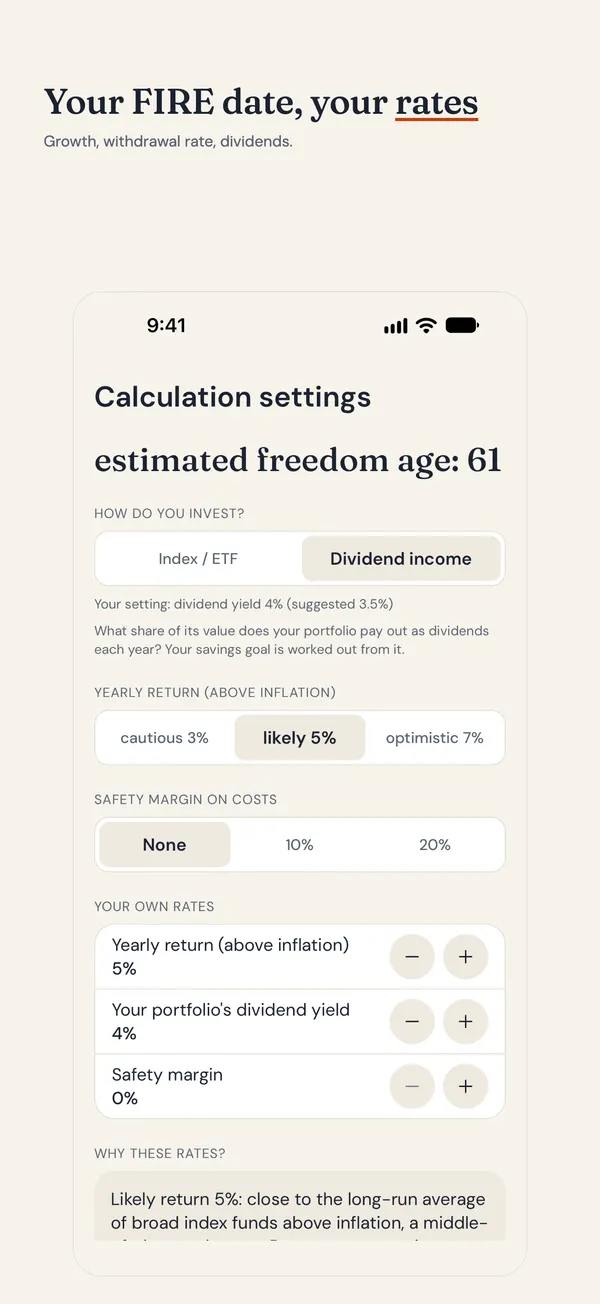
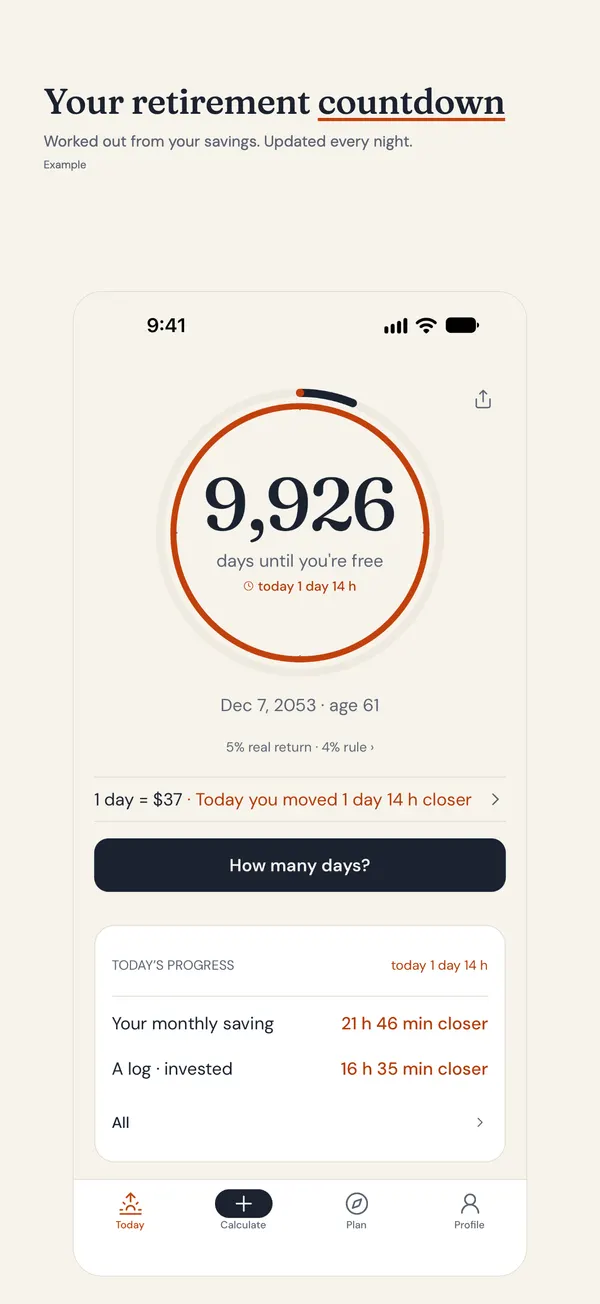
Untilfree uses 4% by default for index funds, or a 3.5% dividend yield, and you can change it. It then shows your freedom date and counts down.
- Withdrawal rate or dividend yield: both free to change
- Cautious, likely and optimistic dates
- Your own growth rate and safety margin with Plus
App Store · Free · Ads, optional Plus · No account · No bank link
Untilfree gives estimates in today’s money (after inflation). Taxes and state pensions are not included. This page is general information, not investment advice.
Published · by Srofia