 Untilfree
Safe Withdrawal Rate for a Long Early Retirement
A 30-year retirement and a 50-year one are different problems. The longer the money has to last, the less room there is for a bad stretch, so the starting rate usually comes down.
Why length changes the rate
The 4% rule was tested over 30 years. Over 50 or 60 years, a pot has to survive more bad decades, and it cannot rely on being allowed to run down near the end. Research that extends the same historical tests to longer periods finds lower safe starting rates.
What the long-horizon research says
The most detailed public work is the "Safe Withdrawal Rate" series on the Early Retirement Now blog, which tests 30, 40, 50 and 60-year periods using US data back to 1871. Its headline finding: a 4% start that succeeds about 95% of the time over 30 years succeeds only around two-thirds of the time over 60 years. The author's rule of thumb for long retirements is "3.5% is the new 4%", and lower when markets look expensive.
The bands used in the estimate above are a rough summary of that idea, not an exact rule:
- Up to 30 years: about 4%.
- 31 to 45 years: about 3.5%.
- Over 45 years: about 3.25%.
What half a percent means in money
On $1 million, 4% is about $3,330 a month, 3.5% about $2,920 and 3.25% about $2,710. To keep the same spending at a lower rate, the pot has to grow: $40,000 a year needs $1 million at 4% but about $1.14 million at 3.5% and $1.23 million at 3.25%.
Leo plans to stop at 42 and expects the money to last 50 years or more. He spends $3,000 a month. At 4% his target would be $900,000; at 3.25% it is about $1.1 million. He decides to aim at 3.5% and keep the option of a few years of part-time work, which lowers the risk of the early years without making the target much bigger.
Flexibility is worth a lot
Most studies assume you never change your spending. Real retirees do. Common approaches include skipping the inflation raise after a down year, setting a floor and a ceiling for spending, or keeping a year or two of costs in cash. Any of these lets a plan start a little higher than a fixed rule would allow.
For ages, the retire at 40 and retire early guides put these rates into age-specific plans.
Questions people ask
What is a safe withdrawal rate for a 40-year retirement?
Many long-horizon studies point to around 3.5%, a little below the 30-year 4% figure. It depends on your mix of investments, fees and how flexible your spending is.
What is a safe withdrawal rate for a 50-year retirement?
Often somewhere between 3.25% and 3.5%. Over 50 years a pot has to survive more bad stretches, so the starting rate is usually lower.
Is 3% too low?
It is very cautious. Historically, 3% held up over almost every long period tested, but it needs a much larger pot. Many people pick a rate in between and stay flexible.
Does the safe withdrawal rate change with age?
It changes with how long the money must last, which is closely linked to age. Someone retiring at 65 can usually start higher than someone retiring at 40.
Does a pension or Social Security change it?
Yes. Income that starts later means the pot only needs to carry the full load for some years, which allows a higher draw early on. Untilfree counts only your savings.
Set your rate, see your date
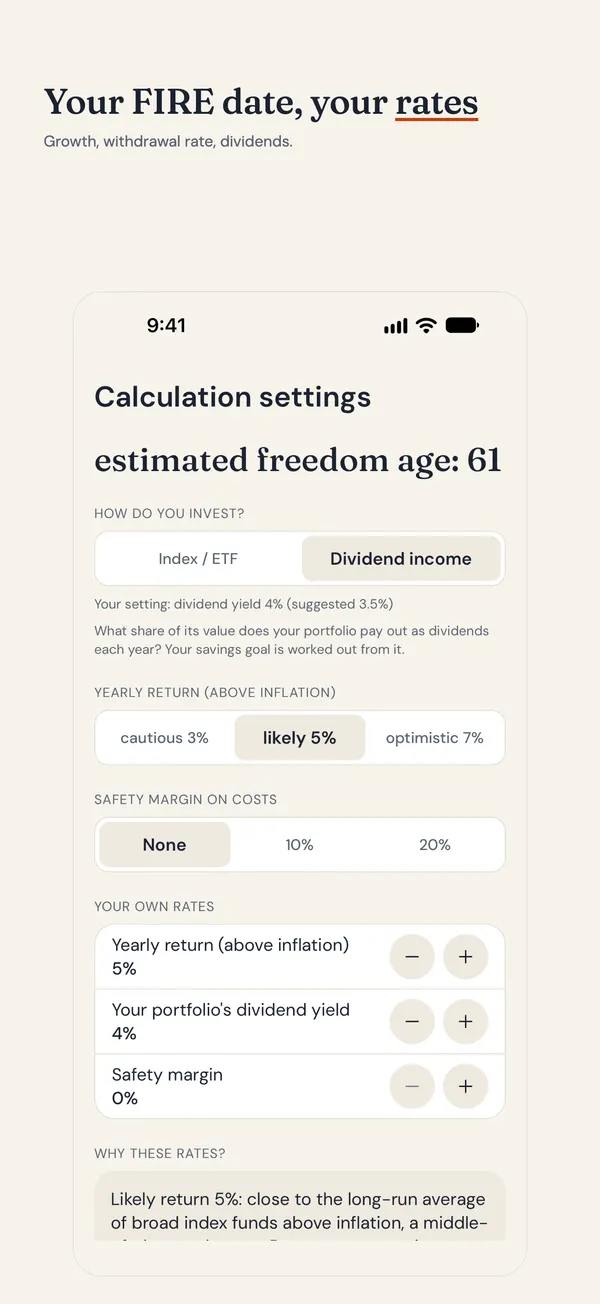
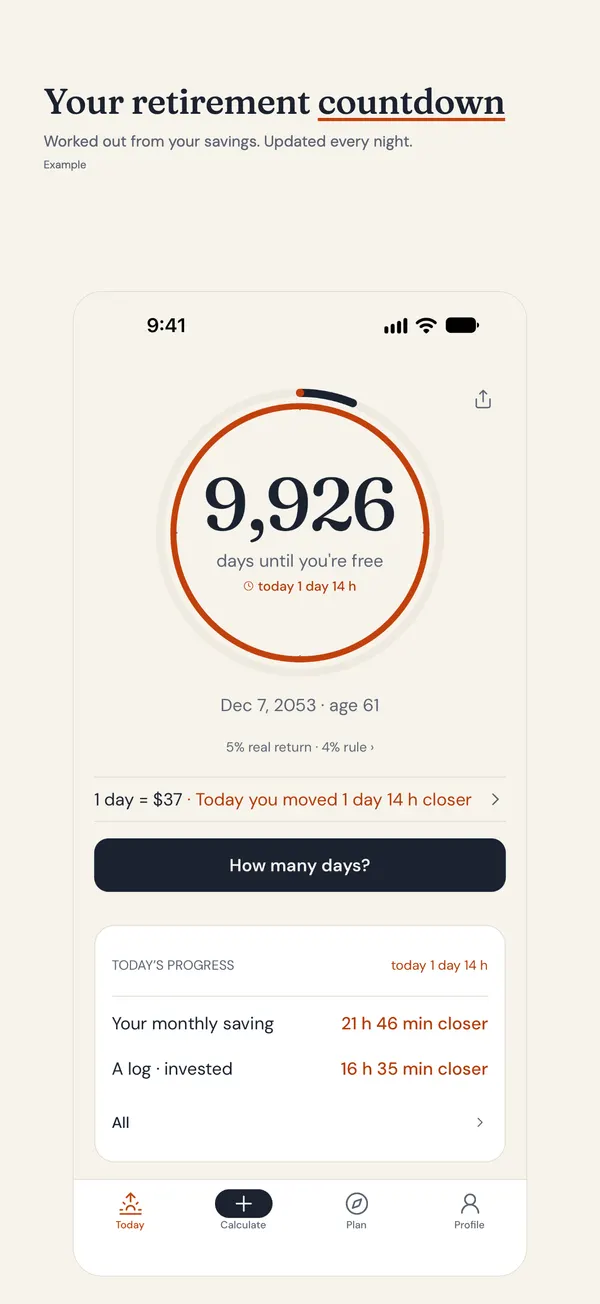
In Untilfree the withdrawal rate is yours to set. Change it from 4% to 3.5% and see how far your freedom day moves.
- Withdrawal rate or dividend yield: free to change
- Cautious, likely and optimistic dates
- Your own safety margin with Plus
App Store · Free · Ads, optional Plus · No account · No bank link
Untilfree gives estimates in today’s money (after inflation). Taxes and state pensions are not included. This page is general information, not investment advice.
Published · by Srofia