 Untilfree
Can You Retire at 40? A Realistic Look
Retiring at 40 means your money may need to last 50 years or more. That is possible for some people, but it changes the withdrawal rate, the account rules and the health plan.
The long horizon is the whole story
At 40, you may live another 50 years or more. Many people in that position plan on a draw of about 3.5% rather than 4% (the FIRE number guide explains why). A lower rate needs a bigger pot, and that is why this goal is hard.
Sam is 30, has $50,000 saved and spends $3,500 a month. Aiming to stop at 40 with a careful 3.5% withdrawal needs a pot of about $1.2 million, and that means investing roughly $7,400 a month for ten years, at 5% growth after inflation. That is a very high savings rate, which is why many people who start this plan settle on 45 instead.
What 1 million or 2 million can pay
At 3.5%, $1 million pays about $35,000 a year. At 3%, about $30,000. At 4%, about $40,000. Many early retirees live on that, mostly in lower-cost places and with a paid-off home or no children, but it is tight in expensive cities.
At 3.5%, $2 million pays about $70,000 a year, which suits a household that wants more room. If you are asking "can I retire at 40 with 1 million", the honest answer is: yes, if your yearly spending is around $35,000 or less and you accept some risk. Enter your household totals, not just your own. For a closer look, see how long $1 million lasts.
Bridging 19½ years of locked accounts
This is the part that surprises people. In the US, most 401(k) and IRA money is locked behind a penalty until age 59½, so a 40-year-old has nearly two decades to cover from other sources. Rules differ by country, but US savers commonly look at three tools:
- A taxable brokerage account built up on purpose to fund the early years.
- Roth IRA contributions. What you put in, though not the growth, can come out at any time.
- 72(t) payments, a fixed schedule of withdrawals from retirement accounts that avoids the penalty. It is rigid once started, so many people get advice first.
The rule of 55 does not help at 40, since it applies only when you leave an employer in or after the year you turn 55. Taxes are outside what Untilfree models.
Paying for health cover until 65
Medicare starts at 65, which is 25 years after 40. Many early retirees buy a marketplace plan for that whole stretch. Prices depend on state, age and income, so people often budget a generous figure and revisit it every year.
Social Security is far away
Benefits can start at 62, reduced, which is 22 years away. Many early retirees leave it out and treat it as a bonus. Untilfree does the same and counts only your savings.
What makes 40 more realistic
- Spending that is truly low and steady.
- Some income in the first years, even small, which reduces the early draw.
- Flexibility: spend less in a bad market year.
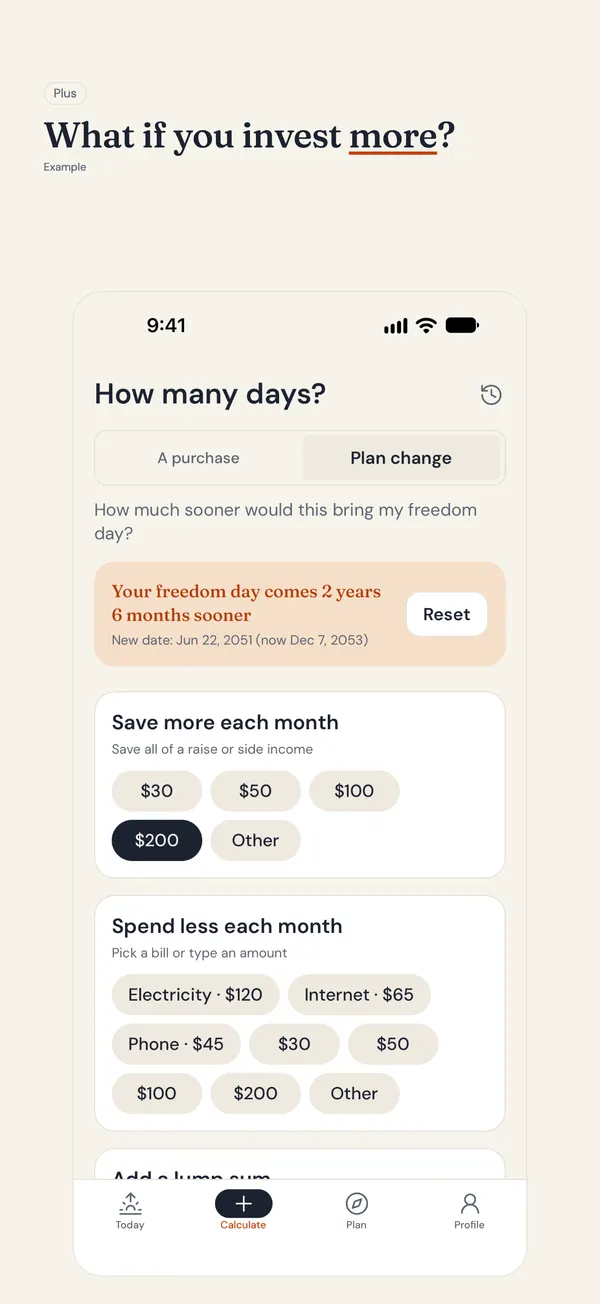
Untilfree's "What if" shows how investing more or spending less moves the date (unlimited for the first 3 days, then 3 a day free; unlimited with Plus). For another angle, compare with retiring at 50.
Questions people ask
Can I retire at 40 with 1 million dollars?
Possibly, if you spend about $35,000 a year or less. At a 3.5% withdrawal, $1 million pays that. It leaves little room for big costs like health cover or a market slump, so most people keep some flexibility.
Can I retire at 40 with 2 million dollars?
It is more comfortable. At 3.5%, $2 million pays about $70,000 a year, enough for many households. Health cover and a long horizon still matter, so the plan needs a margin for surprises.
How do you pay bills at 40 if retirement accounts are locked?
Most people spend from a taxable account first, use Roth IRA contributions, or set up scheduled withdrawals called 72(t). Each has trade-offs and tax effects, so check your own situation before relying on one.
Is retiring at 40 realistic?
For a small number of people it is. It usually needs a high savings rate, low spending and some flexibility. Many people who aim for 40 end up choosing a slightly later date or part-time income.
What does financially free at 40 mean?
It means your investments could cover your usual spending without a job. You may still choose to work, but you no longer have to.
See your own age-40 date
Untilfree takes your age, savings, monthly investing and spending, then shows the date your savings could cover your bills. It counts down to full freedom.
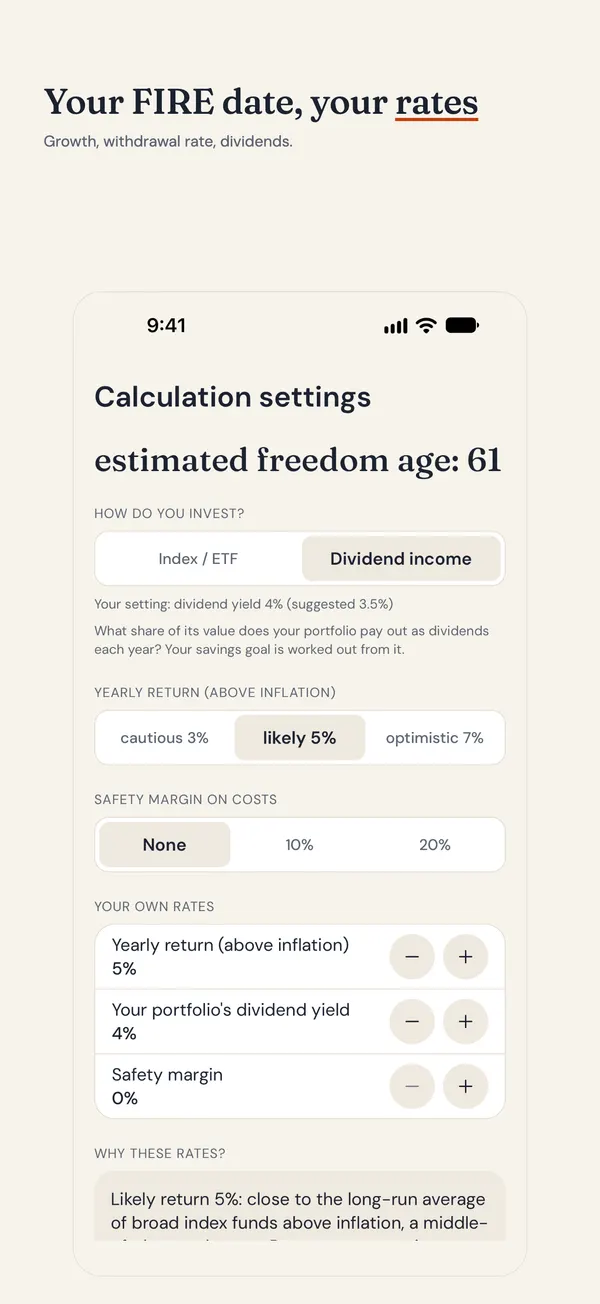
- Pick index funds (4%) or dividend income (3.5%), and adjust the rate
- Try a bigger monthly amount and watch the date move
- No account, no bank link
App Store · Free · Ads, optional Plus · No account · No bank link
Untilfree gives estimates in today’s money (after inflation). Taxes and state pensions are not included. This page is general information, not investment advice.
Published · by Srofia