 Untilfree
What Is Your FIRE Number? Quick Calculator and Guide
FIRE means financial independence, retire early. Your FIRE number is the amount of invested savings that could pay your bills without a paycheck. Here is what moves it, in plain English.
FIRE in one paragraph
Financial independence is the point where your investments could cover your normal spending for the rest of your life, so work becomes a choice. "Retire early" is optional: many people who reach it keep working, just on their own terms. Your FIRE number is simply the size of the pot that gets you there.
The three things that decide your number
- What you spend. This matters more than anything else. Your number is built from your spending, not your salary. Every regular cost you drop lowers the number for good.
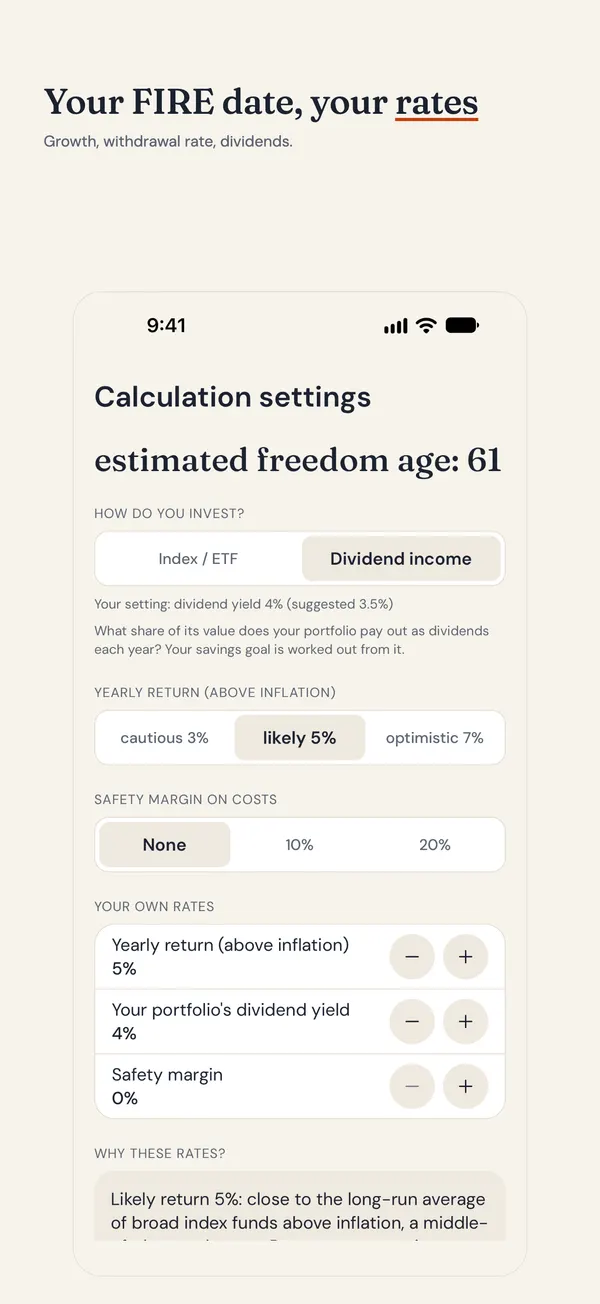
- How much you plan to draw each year. People talk about a "withdrawal rate" — the share of your savings you take out each year. A lower rate is more cautious and needs a bigger pot; a higher rate needs less but carries more risk over a long retirement.
- A safety margin. Some people add a buffer on top, for surprise costs or a rough start in the markets.
How fast you reach it is a separate question. That depends on what you already have, how much you invest each month, and how your investments grow after inflation.
A worked example
Jordan is 32, has $40,000 invested, puts in $1,500 a month and spends $3,000 a month. With the common 4% rule and 5% growth a year after inflation, Jordan's FIRE number comes to $900,000, and the date lands about 23 and a half years away — around age 55.
With more cautious assumptions the same plan says about 64; with optimistic ones, about 52. That spread is normal. Nobody knows future returns, so a range is more honest than a single number.
Why a date beats a total
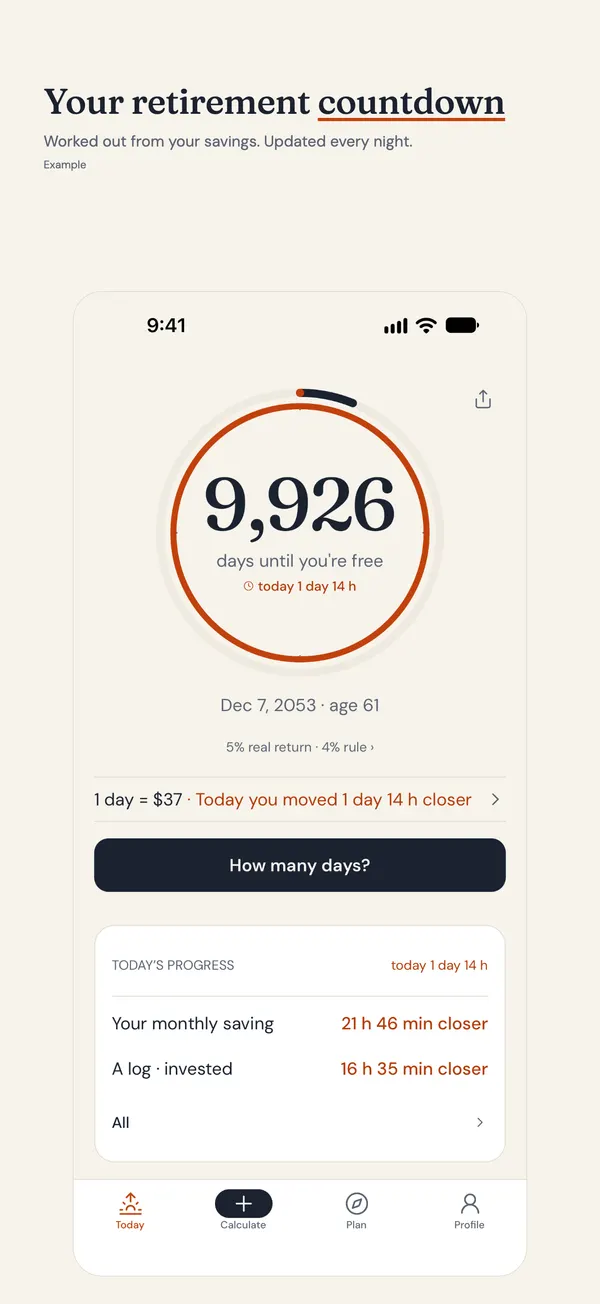
"$900,000" is hard to feel. It is too big to picture and it barely moves when you skip a dinner out. A date is different. "June 2050" is something you can watch get closer, and small choices show up in it as days. That is the idea behind Untilfree: the same maths, shown as a countdown.
Common mistakes
- Using income instead of spending. Two people on the same salary can have very different numbers.
- Mixing today's money with future money. Keep everything in today's money (after inflation) so the number means what it says.
- Treating one result as a promise. Markets move. Check your date once in a while and see how it shifts.
- Forgetting taxes and pensions. Simple FIRE estimates, including ours, leave them out. Your local rules can move the result either way.
Variations you will hear about
Lean FIRE aims for a frugal lifestyle and a smaller number. Fat FIRE aims for a comfortable one and a bigger number. Coast FIRE is the point where you could stop adding to retirement savings and let growth do the rest. Barista FIRE mixes part-time work with a smaller pot. They all start from the same question: what do you actually spend?
Questions people ask
How is the FIRE number calculated?
It is built from your yearly spending and the share of your savings you plan to draw each year. Lower spending or a higher withdrawal rate gives a smaller number; a safety margin makes it bigger. Untilfree works it out from your own numbers in the app.
Which withdrawal rate should I use?
Around 4% is the common rule of thumb, based on research into past retirements of about 30 years. For an early retirement that could last 40 years or more, many people choose a little lower, around 3.25–3.5%, to be safe.
Can I retire early without a high income?
Yes, it is possible. Your savings rate — the share of take-home pay you invest — matters more than your salary. A modest income with low spending can reach independence sooner than a high income with high spending.
Is $80,000 a year enough to reach FIRE?
It depends on what you spend, not what you earn. If you live on a part of it and invest the rest every month, yes, it can be. The more of it you keep, the sooner the date.
Does the FIRE number include my home?
Usually not. Only investments that can pay you an income count. A paid-off home lowers your spending, which lowers your number.
See your own date in Untilfree
Four questions — your age, savings, monthly investing and monthly spending — and Untilfree gives you a date. In under a minute you see your freedom day, how many days are left, and a cautious, likely and optimistic range.
- Choose index funds or dividend income, and your own withdrawal rate
- Price anything in days before you buy it (daily free limit, unlimited with Plus)
- Your numbers stay on your phone
App Store · Free · Ads, optional Plus · No account · No bank link
Untilfree gives estimates in today’s money (after inflation). Taxes and state pensions are not included. This page is general information, not investment advice.
Published · by Srofia