 Untilfree
How Much Money Do You Need to Never Work Again?
There is no single magic total. The amount that would let you stop working depends on what you spend each month, how carefully you plan to draw from it, and how long it needs to last.
Start with spending, not income
The question sounds like it is about a big pile of money, but it is really about a monthly bill. What does your life cost each month — housing, food, transport, insurance, fun? That figure, in today's money, is the base for everything else. Two people with the same savings can be in very different places if one spends twice as much.
Lena spends $2,500 a month. Tom spends $5,000. Using the common 4% rule, Lena needs about $750,000 invested and Tom needs about $1.5 million. Same goal, same rules — and Tom's number is twice Lena's because his life costs twice as much.
How carefully you plan to draw
Investments do not pay a fixed salary. The share you take out each year is your withdrawal rate. Around 4% is the well-known rule of thumb from research on past 30-year retirements. If you stop working at 35 or 40, your money may need to last 50 years or more, so many people choose a little lower, like 3.5%, which means a bigger pot. Some also add a safety margin of 10–20% on top.
Is $1 million enough?
At a 4% rule of thumb, $1 million could support about $40,000 a year — roughly $3,300 a month in today's money, before tax. If your life costs less than that, it may be enough. If it costs more, it is not yet. That is why "a million" is a slogan, not a plan.
Does inflation matter?
Yes, a lot. Prices rise over time, so the amount you need in 20 years will look bigger in future dollars. The simple fix is to plan in today's money: use today's spending and a growth rate after inflation. Then the result means what it says, in today's prices. Untilfree works this way.
Does age change the answer?
Your age changes how long the money must last, and so how carefully you should draw from it. Starting early also gives growth more time to do the heavy lifting. Someone who begins investing at 20 needs to put in far less each month to reach the same number by 50 than someone who starts at 40.
What simple estimates leave out
- Taxes on withdrawals, which depend on your country and account types.
- State pensions, which can lower what you need later in life.
- Big one-off costs such as a new roof or a car, unless you add a safety margin.
- Health costs, which vary hugely by country.
Questions people ask
How much money do you need to never work again?
Enough invested savings to cover your yearly spending at a careful withdrawal rate. For most people that is somewhere between a few hundred thousand and a few million, and the biggest single factor is what they spend.
Is $1 million enough to retire early?
At about 4% a year it could support around $40,000 a year in today’s money. That can be enough for a modest lifestyle in many places, but not for higher spending, and early retirees often choose a lower withdrawal rate.
How much do I need to live off interest alone?
Living only off interest or income, without touching the pot, needs more than living off total returns, because you never sell anything. Dividend investors face the same question — see our guide on living off dividends.
How much do I need to never work again at 30?
You need the same idea, with more care: the money may need to last 50 years or more, so a lower withdrawal rate and a safety margin make sense. The upside is that time is on your side for growth.
Does it matter which country I live in?
Yes, because spending, taxes, health costs and pensions differ. The approach stays the same; your numbers change.
Get your own number — and a date — in Untilfree
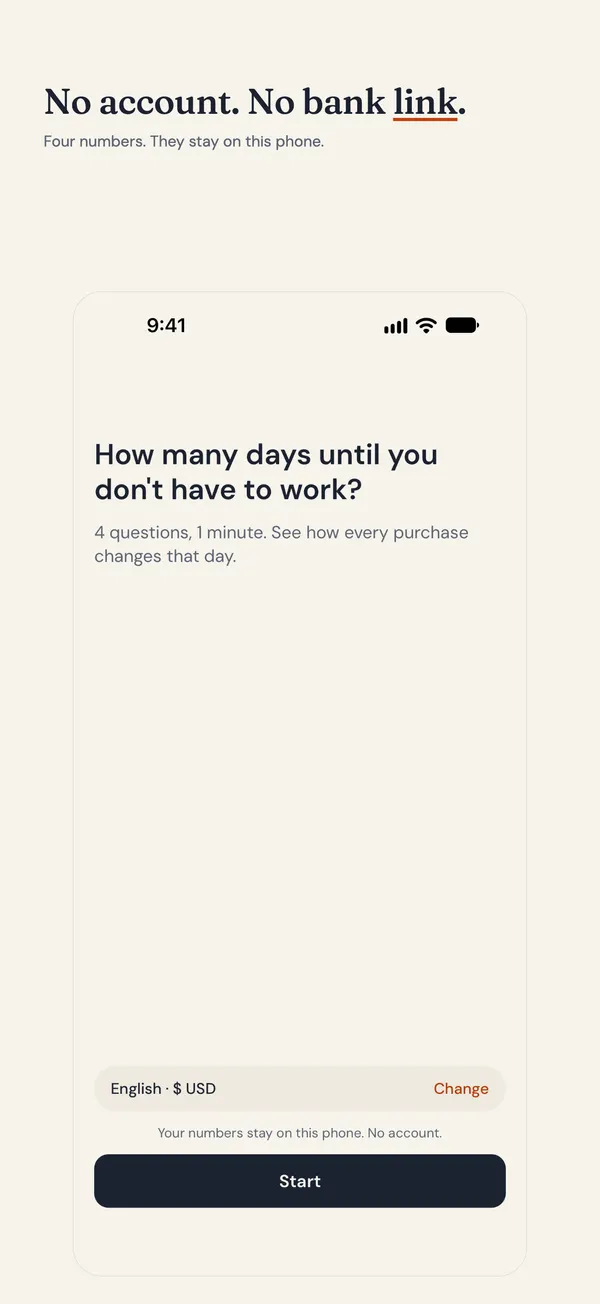
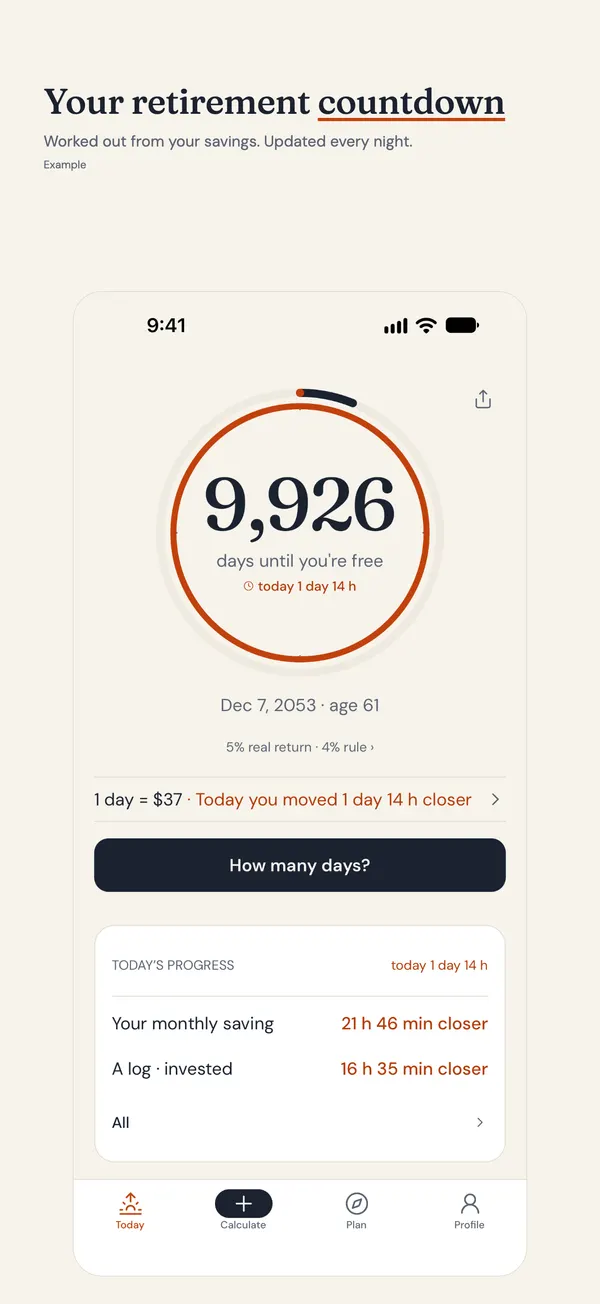
Four questions — your age, savings, monthly investing and monthly spending — and Untilfree gives you a date. It shows how much you need, the day you could get there, and how each choice moves it.
- Your own withdrawal rate; safety margin with Plus
- Everything in today’s money
- No account, no bank link
App Store · Free · Ads, optional Plus · No account · No bank link
Untilfree gives estimates in today’s money (after inflation). Taxes and state pensions are not included. This page is general information, not investment advice.
Published · by Srofia