 Untilfree
How Much to Save to Retire in 10 Years
A ten-year plan is short enough to feel real and long enough for growth to help. The question is a monthly number: how much has to go in each month to get there?
Start from the target, then work back
The target is the pot that could pay your yearly spending. With the common 4% rule, that is about 25 times a year of spending: $4,000 a month becomes $48,000 a year and a target of about $1.2 million. Once the target is fixed, the only open question is how much has to go in each month to reach it on time.
Two things pull the monthly figure down: what you already have, and growth. Over ten years, money invested in year one has a lot longer to grow than money added in year nine.
Five, ten or fifteen years
Take someone with $100,000 invested, spending $4,000 a month, and assume 5% growth after inflation:
- In 5 years: about $16,150 a month.
- In 10 years: about $6,850 a month.
- In 15 years: about $3,850 a month.
Halving the time much more than doubles the monthly amount, because there are fewer months and less time for growth. This is why many people pick a 12- or 15-year plan they can keep up, rather than a 5-year plan they cannot.
Dan and Leah have $250,000 invested between them and spend $3,500 a month as a household. Their 4% target is about $1.05 million. To reach it in ten years they would invest roughly $4,250 a month. Cutting $500 from their monthly spending would lower both the target and the monthly amount, the double effect that makes spending such a strong lever.
Which number to change
- Spending. Lowers the target and frees money to invest at the same time.
- Monthly investing. The direct lever, limited by income.
- The date. A couple of extra years often takes thousands off the monthly figure.
How your savings rate links to the number of working years is covered in savings rate and years to retire.
If ten years from now is still young
If the ten-year date puts you in your 40s, the money may need to last 50 years, and many planners use a lower draw than 4% for that. That makes the target bigger. The guide to safe withdrawal rates for long retirements covers this, and US account access rules are covered in retire at 55.
Questions people ask
How much do I need to save to retire in 10 years?
It depends on your spending and what you have now. With $100,000 saved and $4,000 a month of spending, it is roughly $6,850 a month at 5% growth after inflation and a 4% rule target.
Can I retire in 5 years?
Only with a large pot already, very low spending, or a very high income. In the example above, five years needs about $16,150 a month, more than twice the ten-year figure.
Is it realistic to retire in 10 years starting from zero?
For some people. It typically means saving well over half of take-home pay. Many people combine a slightly longer timeline with lower spending to make it workable.
What return should I assume?
Untilfree uses 5% a year after inflation as a middle case, and shows cautious and optimistic dates beside it. Real returns vary a lot from one decade to the next.
Does this include Social Security or a pension?
No. These estimates count only your own savings. A pension or state benefit later would lower what your savings need to cover.
Turn ten years into a date
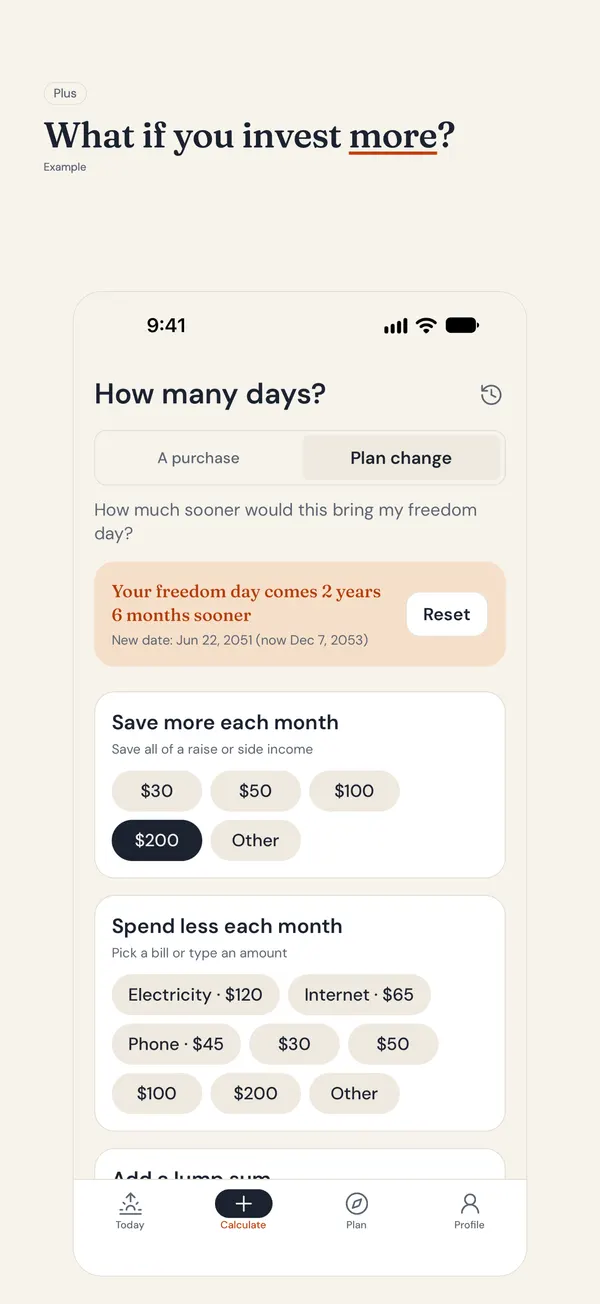
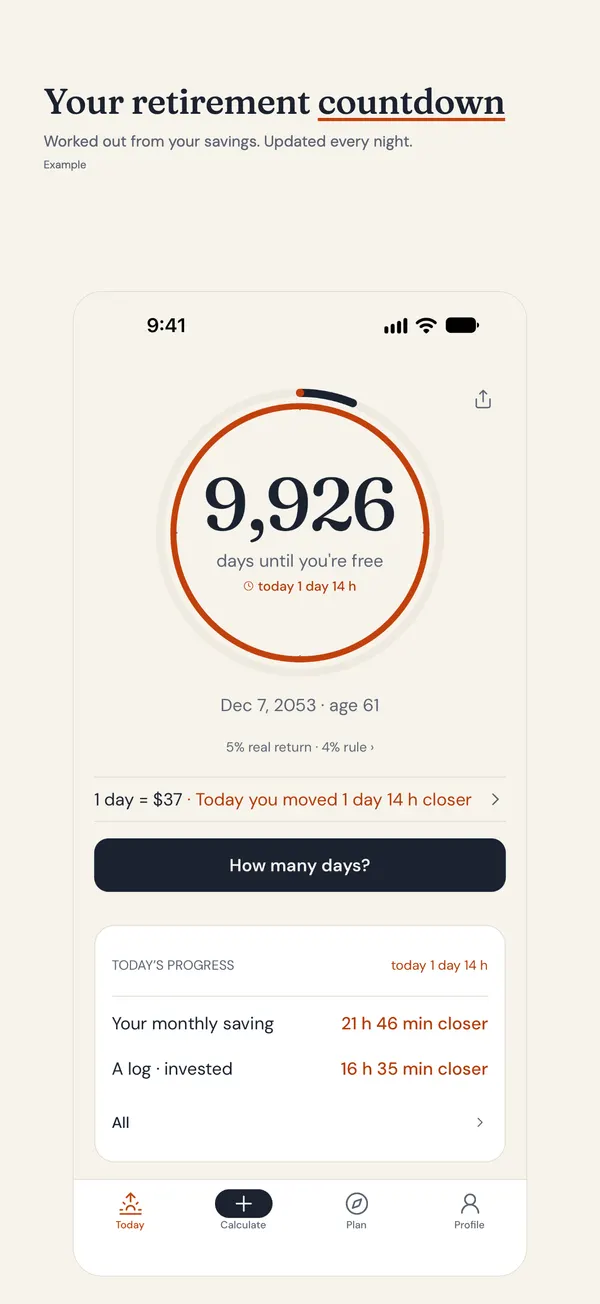
Untilfree takes your savings, monthly investing and spending, then shows your freedom date and counts down to it every night.
- See the day move when you invest more or spend less
- Milestones on the way, with one morning note a day at most
- Your numbers stay on your phone
App Store · Free · Ads, optional Plus · No account · No bank link
Untilfree gives estimates in today’s money (after inflation). Taxes and state pensions are not included. This page is general information, not investment advice.
Published · by Srofia