 Untilfree
Retire at 55: Rules, Numbers and the Gap Years
Fifty-five is where early retirement starts to meet the official rules. One US account rule opens at this age, but health cover and Social Security are still years away, so the plan has to bridge them.
What the rule of 55 actually allows
In the US, money in a 401(k) or 403(b) normally carries a 10% extra tax if you take it out before 59½. The rule of 55 is an exception with three conditions:
- Timing. You leave that employer in or after the calendar year you turn 55. Leaving at 54 and waiting does not count.
- Which plan. It covers the plan of the employer you just left, not plans from older jobs and not IRAs.
- Money stays in the plan. Rolling the money into an IRA usually means losing the exception for that money.
Some public safety workers can use the same rule from 50. Normal income tax still applies either way, and plans can set their own withdrawal options, so many people read their plan rules before choosing a leaving date. Untilfree does not model taxes or account rules.
What 1 or 2 million pays from 55
Stopping at 55 often means a 35- to 40-year retirement, which sits between the classic 30-year research and the much longer early-retirement horizons. At 4%, $1 million pays about $40,000 a year and $2 million about $80,000. People who want more room for a long horizon often look at 3.5%, which gives $35,000 and $70,000.
Priya is 40, has $150,000 invested and spends $4,500 a month. To stop at 55 with a 4% draw she needs about $1.35 million. At 5% growth after inflation, that means investing roughly $4,000 a month for fifteen years. Starting at 45 with $300,000 and a $5,000 budget, the same goal takes about $6,700 a month for ten years.
For the full picture on the larger pot, see how long $2 million lasts.
Ten years to Medicare
Medicare generally starts at 65. From 55 that is a decade of buying cover yourself, often through the marketplace or a former employer's plan for a limited time. Many retirees at this age treat health cover as its own line in the budget rather than part of "everything else".
Seven years to Social Security
Benefits can start at 62 with a permanent reduction; for people born in 1960 or later, the full amount comes at 67. Someone stopping at 55 has seven years to cover with savings alone at minimum. Untilfree counts only your savings, so any future benefit would be on top.
The first years matter most
A big market fall in the first few years of withdrawals does more damage than the same fall twenty years in. People retiring at 55 commonly use one or more of these cushions:
- A year or two of spending held in cash or short-term bonds.
- A spending plan that can shrink a little in a bad year.
- A few years of part-time income, which lowers the early draw.
The trade-offs between stopping at 50 and at 55 are laid out in retire at 50; this page is about what changes once the account rules start to open.
Questions people ask
Can I retire at 55 with 1 million?
It can work if your spending is around $35,000 to $40,000 a year and you have a plan for health cover until 65. Many people at this level keep some flexibility or a little part-time income in the first years.
Can I retire at 55 with 2 million?
For many households, yes. At 4% it pays about $80,000 a year, or about $70,000 at a more careful 3.5%. The main costs to plan for are health cover before Medicare and a weak market early on.
Does the rule of 55 apply to an IRA?
No. It applies to the 401(k) or 403(b) of the employer you leave in or after the year you turn 55. IRAs follow the 59½ rule, with their own separate exceptions.
What if I leave my job at 54?
Then the rule of 55 does not apply to that plan, even if you wait until 55 to withdraw. The leaving date is what counts, which is why some people time their last day carefully.
How much do I need to retire at 55?
A common starting point is 25 times your yearly spending (the 4% rule). With $60,000 a year that is about $1.5 million. The estimate at the top shows the monthly amount for your own numbers.
See if 55 fits your numbers
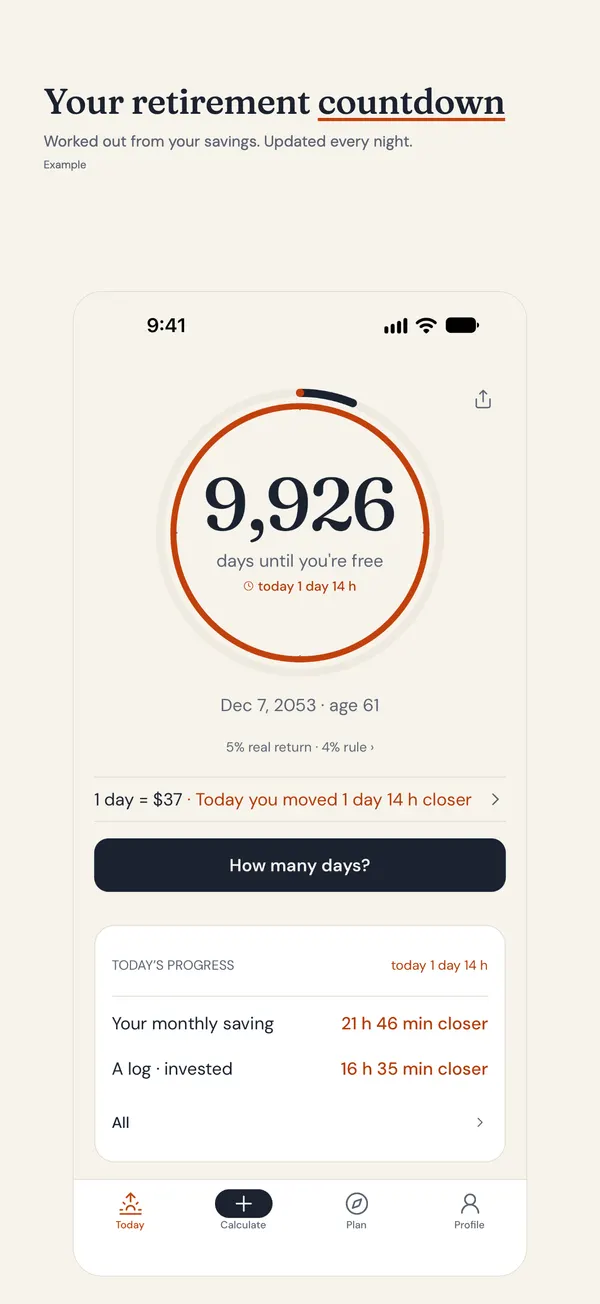
Enter your savings, monthly investing and spending. Untilfree shows the date your savings could cover your bills, with a cautious, likely and optimistic range.
- Exact date and age when free
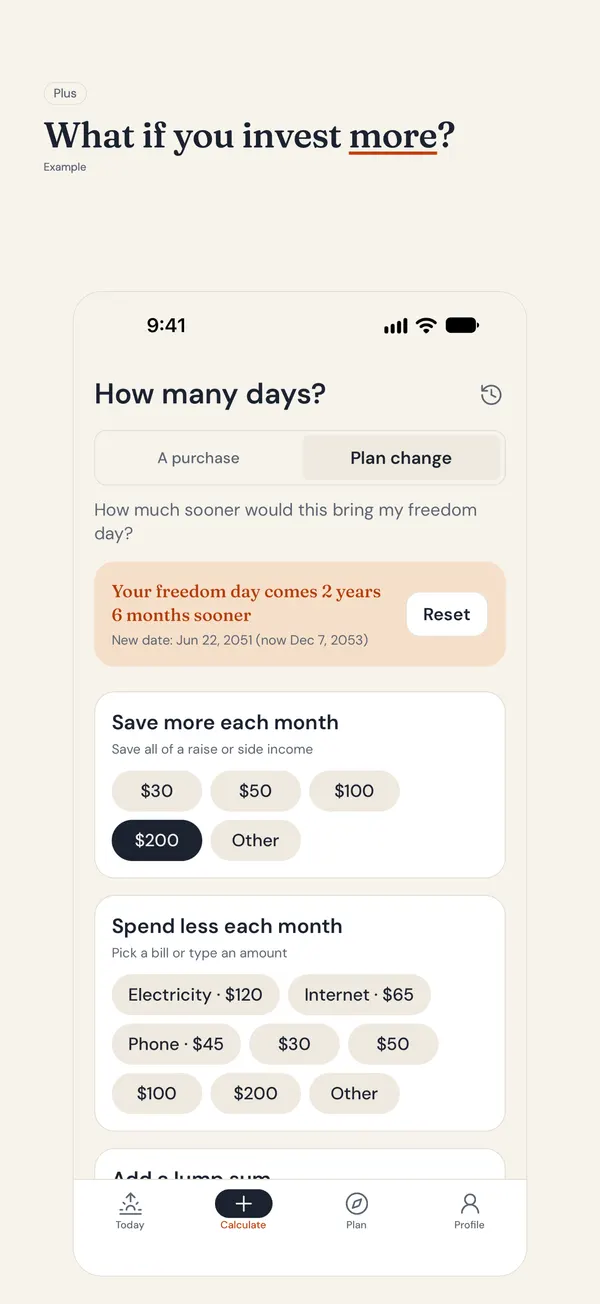
- "What if" shows how $200 more a month moves it (unlimited for the first 3 days, then 3 a day free)
- No account and no bank link
App Store · Free · Ads, optional Plus · No account · No bank link
Untilfree gives estimates in today’s money (after inflation). Taxes and state pensions are not included. This page is general information, not investment advice.
Published · by Srofia