 Untilfree
The Rule of 72: How Long Until Your Money Doubles
Divide 72 by a yearly growth rate and you get roughly how many years it takes for money to double. It is a quick mental check that makes compound growth easy to see.
How it works
At 6% a year, 72 ÷ 6 = 12, so money doubles in about 12 years. At 9%, about 8 years. At 3%, about 24. The exact maths uses logarithms, but 72 is close for the rates most people deal with, and it divides neatly by 2, 3, 4, 6, 8, 9 and 12.
It works in reverse too: to double money in 10 years, you need about 7.2% a year.
Real growth, not the headline
A stock market average of 8% or 10% sounds great, but some of that is inflation. Doubling in nominal dollars is not doubling what you can buy. Untilfree uses 5% after inflation as its middle case, which by the rule of 72 is roughly 14 years to double in real terms (the exact figure is about 14.2).
What it tells a saver
- Early money works hardest. $10,000 invested at 25 can double about three times by 67 at 5% real growth, to close to $78,000 in today's money.
- Fees matter. A 1% yearly fee turns 5% into 4%, and the doubling time goes from about 14 years to about 18.
- Debt doubles too. A card balance at 24% doubles in about 3 years if it is not paid down.
Jess skips a $50 takeaway and invests it. At 5% real growth it is about $100 in 14 years and about $200 in 28. It is not a reason to never buy a takeaway; it is a way to see what a habit costs over time, the idea behind the latte factor.
Where it stops being useful
The rule of 72 assumes a steady rate, which real markets never deliver. It is a feel for scale, not a forecast. For a goal like "when could I stop working", what matters is the whole path: savings, monthly investing and spending, which is what savings rate and years to retire works through.
Questions people ask
What is the rule of 72?
A shortcut: 72 divided by a yearly growth rate gives roughly the years needed to double your money. At 8%, it is about 9 years.
How accurate is the rule of 72?
Very close for rates between about 4% and 12%. At 5% it says 14.4 years against an exact 14.2. At very high rates it drifts further off.
Why 72 and not 70?
Both are used. 69.3 is the precise figure for continuous growth; 72 is slightly better for yearly compounding at typical rates, and divides by more numbers.
How long does it take to double money at 5%?
About 14 years. If 5% is your growth after inflation, that is 14 years to double what your money can buy.
Can I use the rule of 72 for inflation?
Yes. At 3% inflation, prices double in about 24 years, which is why long plans work in today's money.
See growth turn into a date
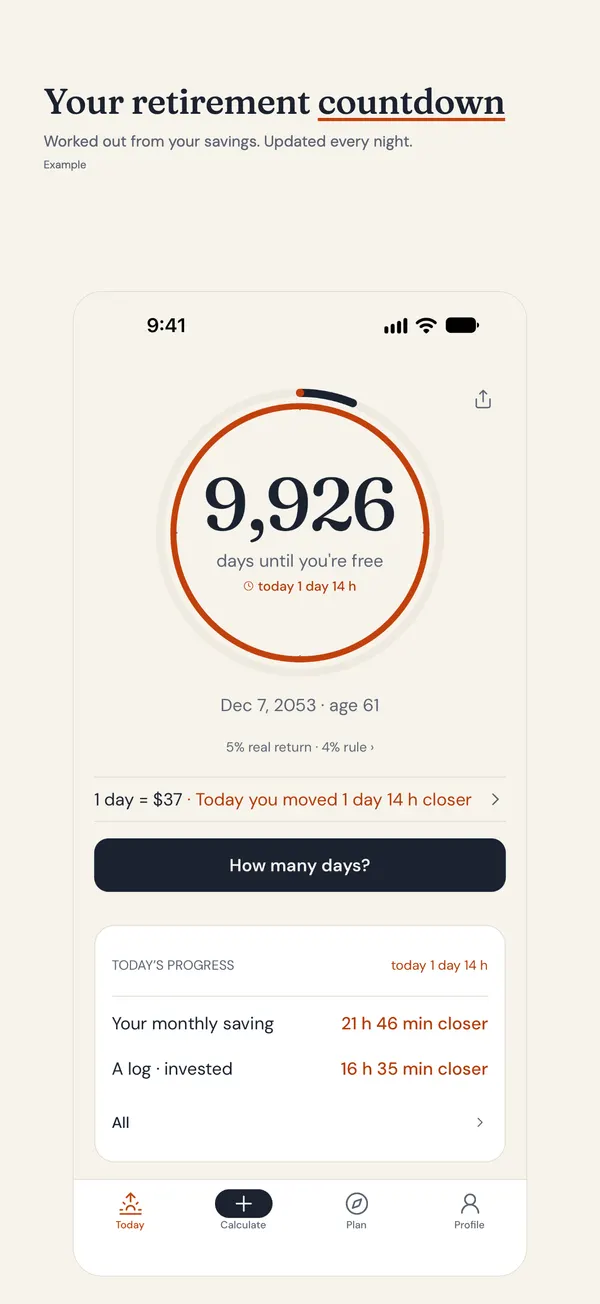
Untilfree uses 5% growth after inflation as its middle case and shows a cautious and an optimistic date beside it. Your own growth rate is a Plus setting.
- Exact date and countdown
- Cautious, likely and optimistic range
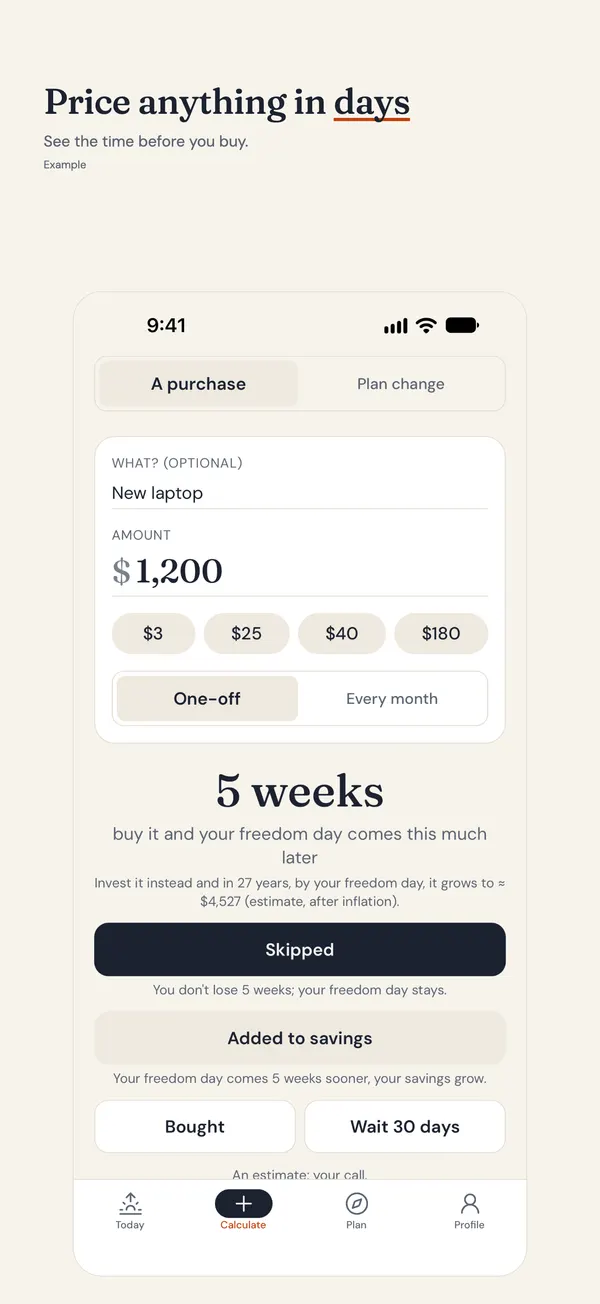
- Price a buy in days of freedom (unlimited for the first 3 days, then 3 a day free)
App Store · Free · Ads, optional Plus · No account · No bank link
Untilfree gives estimates in today’s money (after inflation). Taxes and state pensions are not included. This page is general information, not investment advice.
Published · by Srofia