 Untilfree
What Is My Lean FIRE Number? Meaning and Example
Lean FIRE means reaching financial independence on a small yearly budget. The smaller your spending, the smaller the pot you need, and the earlier you can stop.
Lean FIRE meaning
Lean FIRE is the frugal version of early retirement. Nobody defines it officially, but in the US many people use roughly under $40,000 a year of spending as the lean zone. That is a loose guide: $40,000 is comfortable in a small town and tight in a big city. Your own lean number is the pot that could pay your lean budget, year after year.
A few lean budgets in words
Using the common 4% rule, a budget of $2,000 a month points to about $600,000. At $2,500 a month it is about $750,000, and at $3,300 a month it is about $990,000. Each extra $100 you spend every month adds about $30,000 to the target. That is why frugal spending is so powerful: it cuts the goal and gives you more years to save toward it.
Sam is 30, has $30,000 invested, adds $1,000 a month and spends $2,000. At 5% growth after inflation, Sam's date is about 23 years away. A friend with the same savings who spends $3,500 is about 32 years from the finish. Same savings, same investing, nine extra years, all from spending.
What forums keep debating
If you read Lean FIRE threads on Reddit and similar forums, the same worries come up.
- Is it too tight? A lean plan has little spare room. People who succeed usually keep a buffer and a few skills that could earn money again.
- Healthcare. In the US it is often the biggest unknown for early retirees. Plan for it as a real line in your budget; rules and prices differ by country and state.
- Lifestyle creep in reverse. Cutting too hard can be hard to sustain. A budget you resent is a budget you break.
- A long retirement. Stopping young means more years to fund; the FIRE number guide covers how people allow for that.
Lean does not have to mean bare
A good lean budget includes what you actually value. Some people spend very little on housing and cars and keep travel or hobbies. Others do the reverse. What makes it work is knowing which costs you could cut in a bad year and which you refuse to.
Could you start with your bills?
A big number like $600,000 is easy to lose track of. Bills are easier. Phone, internet, insurance and food each have a monthly price, and your savings can take them on one at a time. The smallest bills get covered first, long before you reach the whole number. Untilfree shows this: add your bills and it tells you which ones your savings already pay for, forever, smallest first.
Is Lean FIRE right for you?
It suits people who already live simply, who have low fixed costs, or who want to leave a demanding job as soon as they can. If your budget is bigger, look at Chubby FIRE or compare all the types. If you are not sure what you spend, start with the FIRE movement basics.
Questions people ask
What is a Lean FIRE number?
It is the amount of invested savings that could pay a small yearly budget without a paycheck. With the common 4% rule it is about 25 times that budget, so $24,000 a year points to roughly $600,000.
What counts as Lean FIRE?
There is no official line. In the US, many people say yearly spending under roughly $40,000, but cost of living, family size and health needs change what lean really means.
What is my Lean FIRE number if I spend $30,000 a year?
With the 4% rule, about $750,000. With a more cautious 3.5% rule for a very long retirement, roughly $860,000. The right choice depends on how many years your money must last.
Is Lean FIRE realistic?
It can be, especially with low housing costs and a plan for healthcare. The weak spots are little slack for surprises and a long retirement, so use a cautious return and keep a buffer.
Can I do Lean FIRE with a family?
Yes, but your household spending sets the number, so a family usually needs a bigger pot than a single person. Enter your household totals and use your real costs.
See which bills your savings already pay
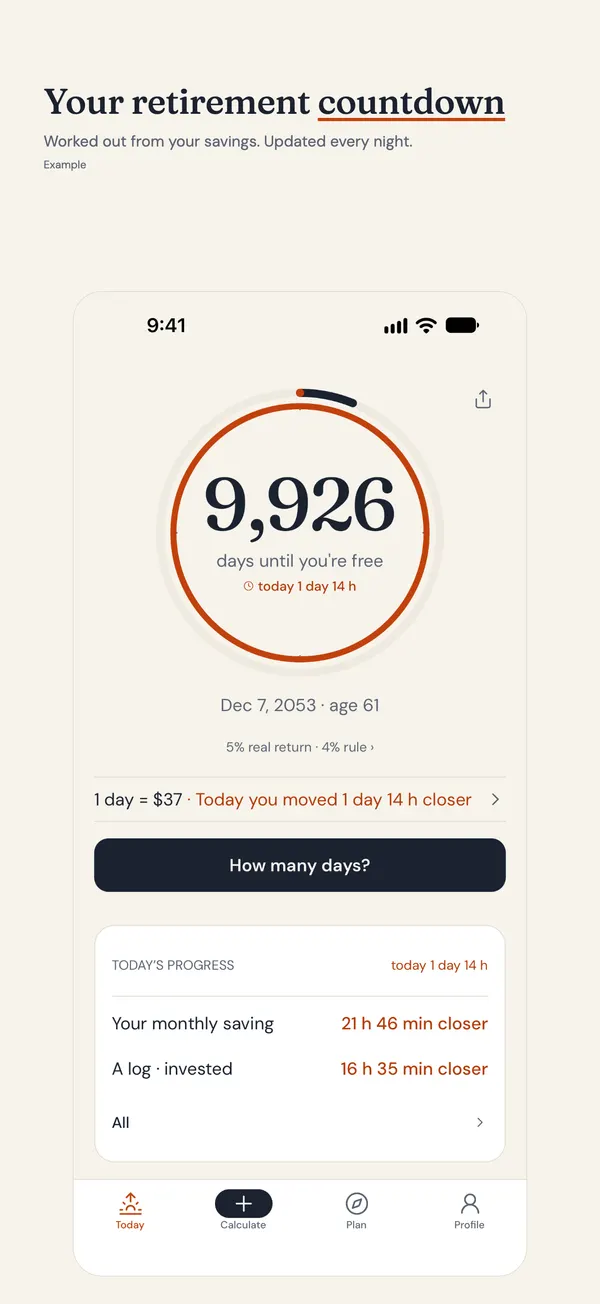
Four questions — your age, savings, monthly investing and monthly spending — and Untilfree gives you a date. Add your bills and Untilfree shows which ones your savings already cover, smallest first.
- Bills paid for, forever, one by one
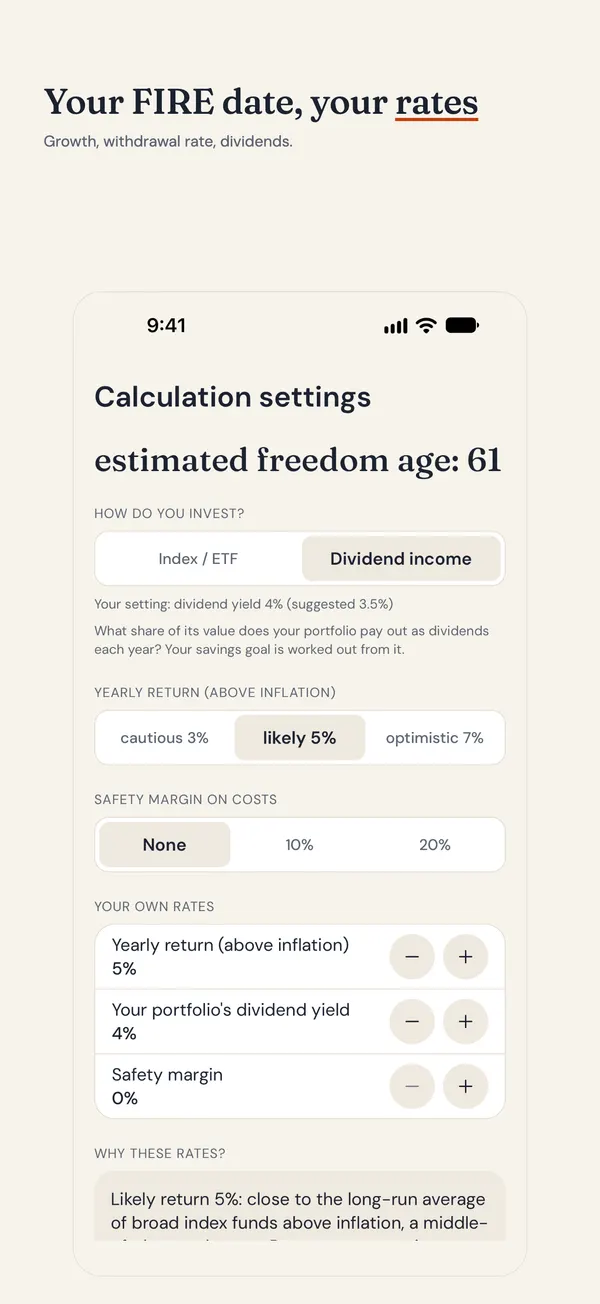
- Index funds (4%) or dividend income (3.5%), with an adjustable rate
- Exact date and a countdown that drops every night
App Store · Free · Ads, optional Plus · No account · No bank link
Untilfree gives estimates in today’s money (after inflation). Taxes and state pensions are not included. This page is general information, not investment advice.
Published · by Srofia