 Untilfree
How Many Years Does It Take to Save Your First $100K?
The first $100,000 is slow because almost all of it comes from you, not from growth. After that, the pace changes.
Why the first $100K is the hardest
When your balance is small, growth does very little. If you hold $5,000 and the market grows 5% in a year, that is $250. Meanwhile your own monthly deposits add thousands. So in the early years you are the engine.
Past $100,000 something changes. The same 5% on $100,000 is $5,000 a year, which is like a bonus you did not work for. Many people say the second $100,000 feels much faster than the first, and that is not a trick of the mind. It is how growth works, and it is why this is a milestone worth celebrating.
How long does it take?
These rough times start from zero and assume 5% growth a year after inflation, in today's money. They are examples, not a forecast.
- $500 a month: about 12 years.
- $1,000 a month: about 7 years.
- $2,000 a month: about 4 years.
Look at the first and the last: four times the saving gives about a third of the time. Not perfectly proportional, because growth helps the long plans a little more.
Sam has $10,000 saved and puts in $1,500 a month. About four years later, the balance reaches $100,000. Without the starting $10,000 it would take closer to five. A small head start is worth keeping.
The three levers
- Monthly amount. The strongest lever in the early years. Many people raise it whenever pay goes up, before spending rises to meet it.
- Where you start. An emergency fund, an old account, or a bonus can count as your head start.
- Time. Growth matters less now but gains power the longer you stay in. Staying consistent beats perfect timing.
Is $100K a goal or a stepping stone?
Both. It is not enough to stop working for most people. A 4% draw on $100,000 is about $4,000 a year. But it does something important: it can cover a few months of a job gap, and it starts the snowball. Our guide to how much money you need to quit your job separates a cushion from full freedom, and the savings-rate guide shows why what you keep matters more than what you earn.
Keep going: what comes after
Once you pass $100,000, the road to bigger sums gets shorter than you expect. Our guide on how long it takes to save $1 million shows the whole climb and the long, steady middle. Both numbers feed the real target, which is the amount that would cover your own bills: your never-work-again number.
Staying motivated in the slow years
- Automate the deposit so saving does not depend on willpower.
- Name small milestones, such as the first $10,000, $25,000 and $50,000.
- Look at progress as a share of the finish line, not as a pile you will never reach.
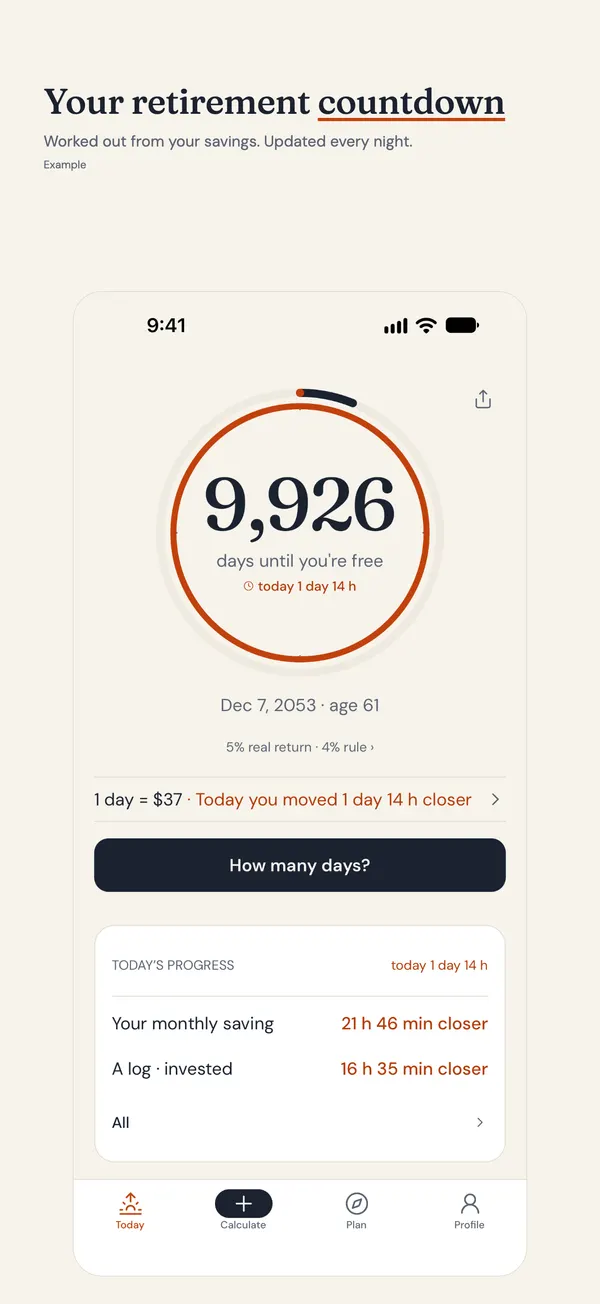
Untilfree helps with the last part: it counts down the days to your freedom date, shows milestones on the way, and sends at most one morning note a day. The count drops by one every night, so progress is visible even when the balance barely moves.
Questions people ask
How long does it take to save $100,000?
It depends on what you save each month. Starting from zero, saving $500 a month takes roughly 12 years, $1,000 a month about 7, and $2,000 a month about 4, assuming modest growth after inflation. A starting balance shortens it.
How many years to save the first 100K on a normal salary?
Many people take five to ten years. The main driver is the monthly amount, not salary alone. A lower-paid worker with low spending can get there as fast as a higher earner who spends more.
Why is the first 100K so hard to save?
Because growth is small on a small balance, so nearly all of it comes from your own deposits. After 100K, investment growth begins to add real money each year, and the next hundred thousand usually comes faster.
Is $100K a lot of money to have saved?
It is a strong milestone, but not enough to retire on for most people. At a 4% draw it pays about $4,000 a year. It is a base for a cushion and a head start toward a bigger goal.
Should I pay off debt before saving $100K?
It depends on the interest rate. High-interest debt usually deserves attention first, since it grows against you. Low-rate debt can often be paid slowly while you invest. This is general information, not personal advice.
Watch the days drop, not just the balance
Untilfree turns your savings and monthly investing into a freedom date and a day count that drops by one every night, with milestones on the way.
- Milestones along the road
- At most one morning note a day
- No bank link; your numbers stay on your phone
App Store · Free · Ads, optional Plus · No account · No bank link

Untilfree gives estimates in today’s money (after inflation). Taxes and state pensions are not included. This page is general information, not investment advice.
Published · by Srofia