 Untilfree
Your True Hourly Wage: What Is Your Time Really Worth?
Your real hourly wage is usually lower than the one on your payslip, because work takes more hours and costs more money than it seems. A common example lands around $16 an hour.
Why the number on your payslip lies a little
Your listed hourly rate counts only the hours you are paid for, before tax. But work also eats commute time, unpaid prep, after-hours emails, and the hours you need to recover. It also costs money to do: fuel or transit, work clothes, lunches, childcare you would not otherwise need. A true hourly wage looks at what is left in your pocket for all the time work actually takes.
A worked example
Sam takes home $3,800 a month and works what feels like 50 hours a week once the commute and unpaid extras are counted. Work costs about $400 a month in fuel, parking and lunches. Instead of the $22 an hour that a normal 40-hour week suggests, Sam's real figure is about $16 an hour.
Sam's raise next year of $200 a month looks nice. Spread over those real hours, it is about $1 an hour. That is useful to know.
The idea behind it: life energy
In Your Money or Your Life, Vicki Robin and Joe Dominguez described money as "life energy": the hours of your life you trade for it. Seen that way, every purchase has a price in hours, not just dollars. A $1,200 laptop is not just $1,200. At Sam's real wage it is about 75 hours of life.
What to count, and what not to
- Count: paid hours, commute, unpaid work you do at home, work trips, and time spent getting ready.
- Subtract: money you spend only because you work, such as transit, parking, uniforms and extra meals.
- Use take-home pay. You spend after tax, so the honest comparison starts there.
- Be honest, not harsh. If you love your work, some of those hours are not a cost. The number is a tool, not a verdict.
Three ways to use your true wage
Judge purchases. "Is this worth 20 hours of my life?" is a different question from "Is this worth $320?" It makes impulse buys easier to say no to, and big wants easier to say yes to on purpose.
Judge jobs. A job paying $5 more an hour but adding a two-hour commute may pay less per real hour. Comparing on true hours is fairer.
Judge the long game. The less you spend, the fewer hours you need to work. That is the path to independence, and it is why the cost of things in hours of work is such a handy habit. For small daily spending, see the latte factor and how little habits add up.
From hours to days of freedom
Hours are a good start, but they stop at the end of your paycheck. The next step is to see what a purchase costs in the time before you can stop working altogether. A $1,200 laptop might cost days or weeks of freedom, depending on your plan, not just 75 hours of work. If you are weighing a bigger leap, how much money you need to quit your job is the next page to read.
Questions people ask
How do I calculate my true hourly wage?
Take your monthly take-home pay, subtract what you spend because of work, then spread what is left over every hour work really takes, including commute and unpaid time. The result is usually lower than your listed rate.
What is a real hourly wage?
It is what you actually earn per hour once you count all work-related hours and costs, not just paid hours. It gives a more honest view of what your time is worth and whether a job is worth it.
How much is my time worth per hour?
Your true hourly wage is one honest answer, but your time is also worth what you could do with it. Some hours are worth more to you than money, like time with family or rest.
Should I include my commute in work hours?
Yes. You cannot use that time for anything else, and it exists only because of the job. Counting it often shows that a long commute can cancel out a pay rise.
What does "life energy" mean in Your Money or Your Life?
Vicki Robin and Joe Dominguez used it to mean the hours of your life you trade for money. Seeing prices as hours of life, not just dollars, helps you spend on what you value.
Price anything in days of freedom
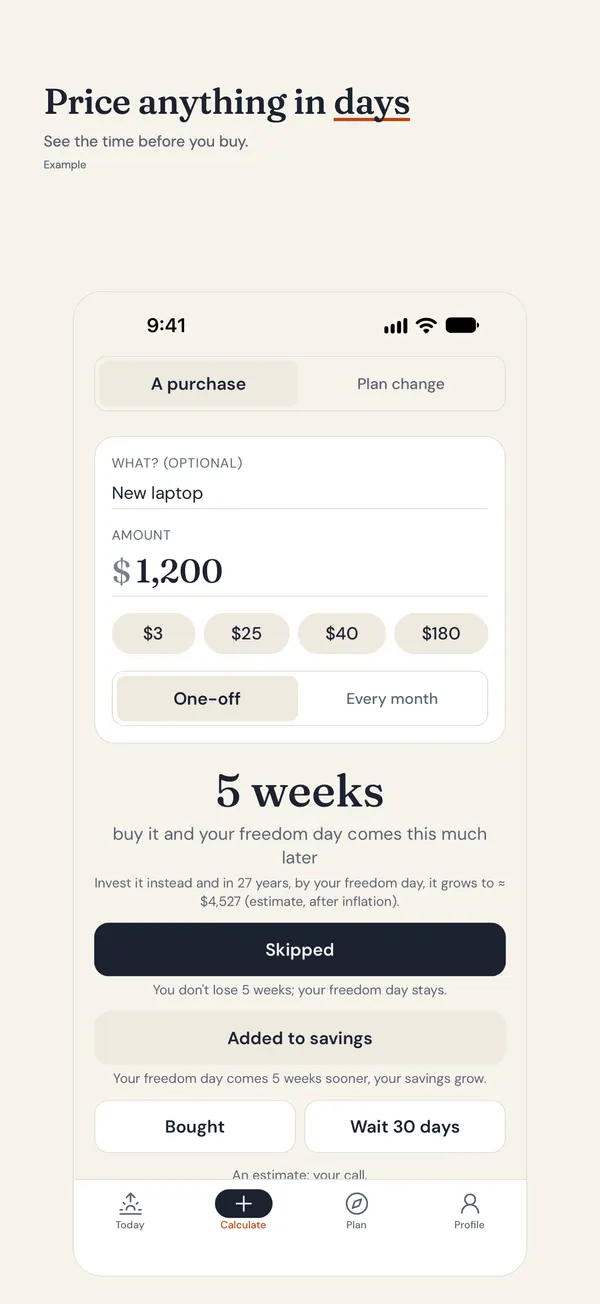
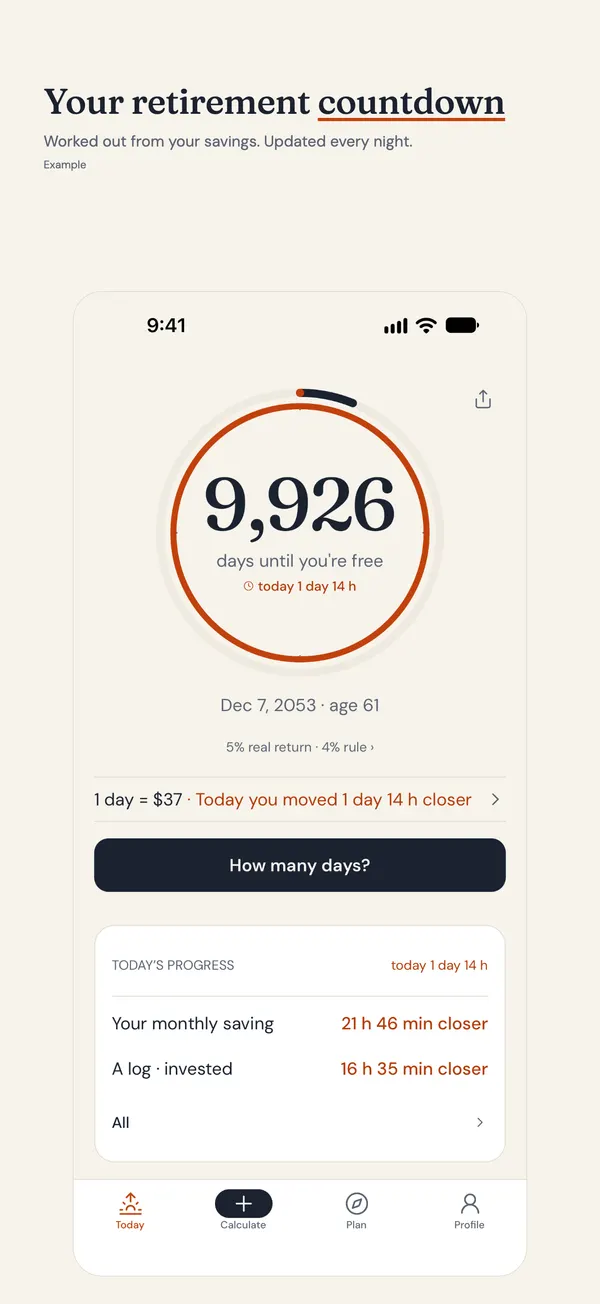
Type a price into Untilfree and see how many days or hours of freedom it costs. Skip it and the date moves closer; buy it on purpose and you know the cost.
- Skipped / Added to savings, your date moves
- Unlimited for the first 3 days, then 3 a day free (unlimited with Plus)
- Wait 30 days wishlist for big wants
App Store · Free · Ads, optional Plus · No account · No bank link
Untilfree gives estimates in today’s money (after inflation). Taxes and state pensions are not included. This page is general information, not investment advice.
Published · by Srofia