 Untilfree
The No-Spend Challenge: Rules, a 30-Day Plan and What It Buys
A no-spend challenge is a set time, often a month, when you buy only what you need. The money you keep is real, but it is easy to shrug at. This page turns it into days of freedom.
The rules
There is no official version. The ones that last share four rules:
- Pick a length and a start date. A weekend, a week or 30 days. A month is long enough to break habits and short enough to finish.
- Write down what is allowed. Usually rent or mortgage, bills, debt payments, groceries, medicine, fuel or transit to work, and anything already booked.
- Write down what is not. Takeaway, eating out, coffee bought out, clothes, gadgets, new subscriptions, and “just this once” online orders.
- Decide where the money goes. Move what you keep into savings or an investment account at the end of each week, so it does not drift back into spending.
Agree a plan for slips before you start. One slip does not end the challenge; note it and carry on.
A 30-day plan
Week 1: set it up
- Go through your last month of card spending and circle what you would not miss.
- Cancel or pause one subscription. See what your subscriptions cost per year.
- Delete saved card details from shopping apps and turn off store emails.
- Shop for groceries with a list, once.
Week 2: replace, don’t just remove
- Plan one free thing for each weekend: a walk, the library, a film night at home.
- Make coffee at home; the latte factor shows what that habit adds up to.
- When you want something, write it on a list with the date. Do not buy it this month.
Week 3: the hard week
- This is when most people slip. Look at what you have kept so far and move it to savings.
- Cook from what is already in the cupboard for a few days.
Week 4: decide what stays
- Look at your want-list. Many items will no longer feel worth it.
- Choose one or two cuts to keep for good. That is where the long-term gain is, as the calculator above shows.
- Move the last of the money and write down your total.
How it changes your freedom date
There are two effects, and the second is much bigger.
- The money you kept. Divide it by what one day of your life costs. If you spend $3,000 a month, a day costs about $99, so keeping $450 buys about four and a half days you will never have to work for.
- The cut you keep. With the 4% rule, every $1 a month you stop spending for good lowers your FIRE number by $300. Keeping a $150 cut makes the number $45,000 smaller, and you can also invest the $150 each month. That can move your date by years, not days.
That is why a no-spend month is most useful as a test: it shows which spending you can drop without missing it.
Lena did a no-spend January and kept $520. At her spending of $2,800 a month, that was about 5.7 days of freedom. She kept one change, no food delivery, worth about $120 a month. Kept for good and invested, that one change moved her freedom date in Untilfree several months earlier.
Make it stick with Price it
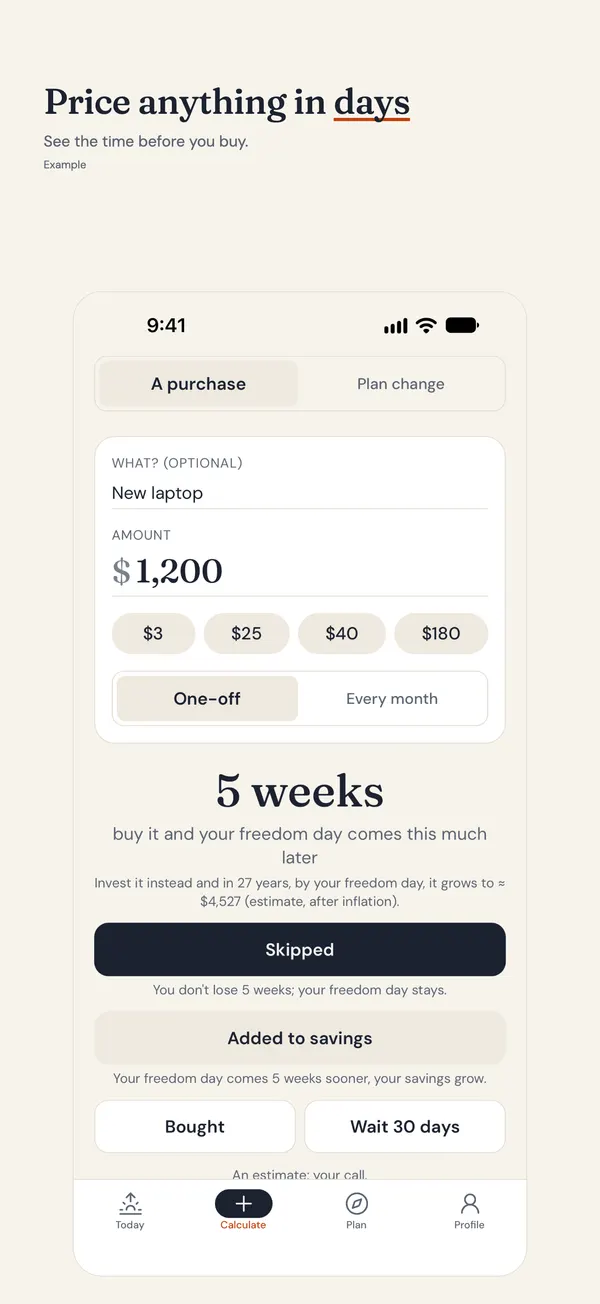
In Untilfree, Price it shows any purchase as time: type in the price and see how much later it would push your freedom day. Mark it Skipped and the money counts as kept, or put it on a 30-day wait, which is a small no-spend challenge for one item. See what things cost in hours of work for more.
Questions people ask
What is a no-spend challenge?
A set period, often a weekend, a week or a month, when you buy only essentials such as bills, groceries and transport, and keep the rest.
What counts as an essential?
You decide before you start. Most people allow housing, bills, debt payments, groceries, medicine, transport to work and anything already booked.
How much can I save in a no-spend month?
It depends on how much of your spending is optional. Many people keep 10% to 20% of a normal month; the calculator above turns your amount into days of freedom.
Is a no-spend January a good idea?
January is the most popular month because it follows the holidays. Any month works; a month with no big events is easier.
What do I do if I slip?
Note it and carry on. The aim is to find spending you do not miss, not to be perfect.
See what a day of freedom costs you
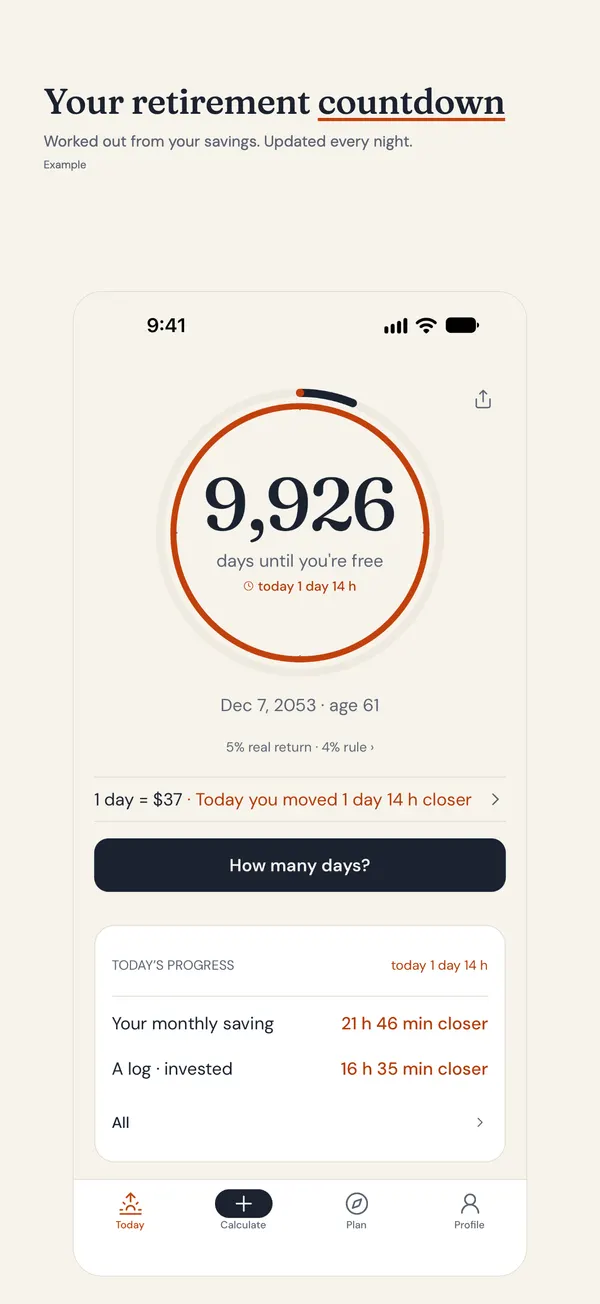
Untilfree works out your freedom date from your own numbers and shows the price of one day. Price it turns any purchase into time before you buy.
- Price it: Skipped, Bought or 30-day wait
- The price of one day of freedom
- No account and no bank link
App Store · Google Play · Free · Ads, optional Plus · No account · No bank link
Estimates in today’s money (after inflation). Taxes, fees and state pensions are not included. This page is general information, not investment advice.
Published · by Srofia